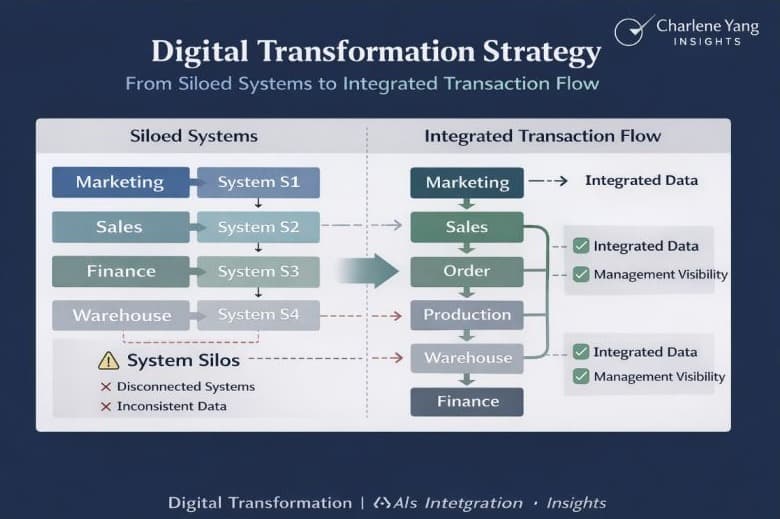
Digital transformation that starts from departmental needs usually ends in rework and integration trouble:
Planning transformation around the transaction flow
Many companies' digital transformations go wrong from the very start.
Marketing implements marketing automation
Sales implements a CRM
Finance implements an ERP
Logistics and warehousing implement TMS/WMS
Every department completes its own digitalization project.
But as the company grows and the CEO wants real-time operating data, the real problems begin to surface.
Core view
In the early stages of digital transformation, many companies start from departmental needs: each department, based on its own KPIs and annual budget, implements the system that best fits its immediate needs.
In the short term this does improve the efficiency of a single department.
But when the company needs to integrate cross-departmental data for operating analysis and decisions, these systems often become a new source of operational friction.
McKinsey research points out:
If a company implements systems before completing process design and data architecture planning, later integration costs can rise 3 to 5 times.
So when planning digital transformation, a company should build on the complete end-to-end transaction flow, not departmental needs.
Content
A company's operations are really one complete transaction flow, for example:
Market development → customer order → purchasing or production → inventory management → shipping and logistics → financial settlement → customer service
Every department is only one node in that flow.
If digital transformation starts only from departmental needs, the result is system silos.
What typically happens early in a transformation
Each department, guided by its KPIs and budget, selects and implements the system that suits it best, without much thought for data exchange between systems or their relative strengths and weaknesses. For example:
- Marketing implements a highly flexible marketing automation platform
- Sales implements a CRM that makes data entry easy
- Finance implements an ERP with strong controls but limited flexibility
- Transport implements a TMS with flexible fleet dispatch
- Warehousing implements a WMS that makes it easy to set up product records and adjust stock differences after counts
In the short term, every department hits its KPIs.
But when the company needs to integrate operating data, the problems begin.
Common problems
- Inconsistent data definitions across systems
- The same data entered repeatedly in different systems
- Rapidly rising system integration costs
- Management reports compiled by hand
In the end the company usually has to pour significant resources into integration, or even re-plan the whole architecture.
The right way to plan transformation
Before implementing any system, a company should first:
- Confirm short-, mid- and long-term operating goals
- Map the complete transaction flow and data flow
- Define the core system architecture
- Assess system module integration needs
- Choose vendors that support the long-term strategy
✅ Only by planning transformation around the transaction flow can costly integration later be avoided.
Case
In the early stage of its digital transformation, one company implemented systems department by department:
- Finance implemented SAP ERP
- Sales and marketing implemented Salesforce CRM
- The factory implemented a local SI's ERP+WMS
At first every department ran well.
But when the CEO wanted a weekly view of:
- Purchase volumes
- Sales order volumes
- Cash flow
- Accounts receivable
- Inventory
problems gradually surfaced. Different data logic across systems led to:
- Inconsistent report definitions
- Different extraction timings
- Manual export and compilation
Every week each department spent considerable staff time compiling reports, and the numbers still did not fully agree.
In the end the company had no choice but to redesign its whole system architecture around the transaction flow.
Consultant's insight
Across many business transformation projects I have seen one common pattern:
The biggest cost of digital transformation is not the systems. It is rework.
When a company does not plan its system architecture from the whole transaction flow at the start,
it usually pays much higher integration costs later.
✨ Closing thoughts
Digital transformation is not the implementation of a single tool. It is a restructuring of how the business operates.
A truly successful transformation must address all of the following at once:
- Process design
- System architecture
- Data governance
- Management decisions
When a company plans transformation around the transaction flow, systems become an amplifier of operating efficiency and decision quality.
Department-
Evelyn YangFounder & CEO, MetricDomain ConsultingPublished